What a Modern Consumer Insights Platform Should Actually Do
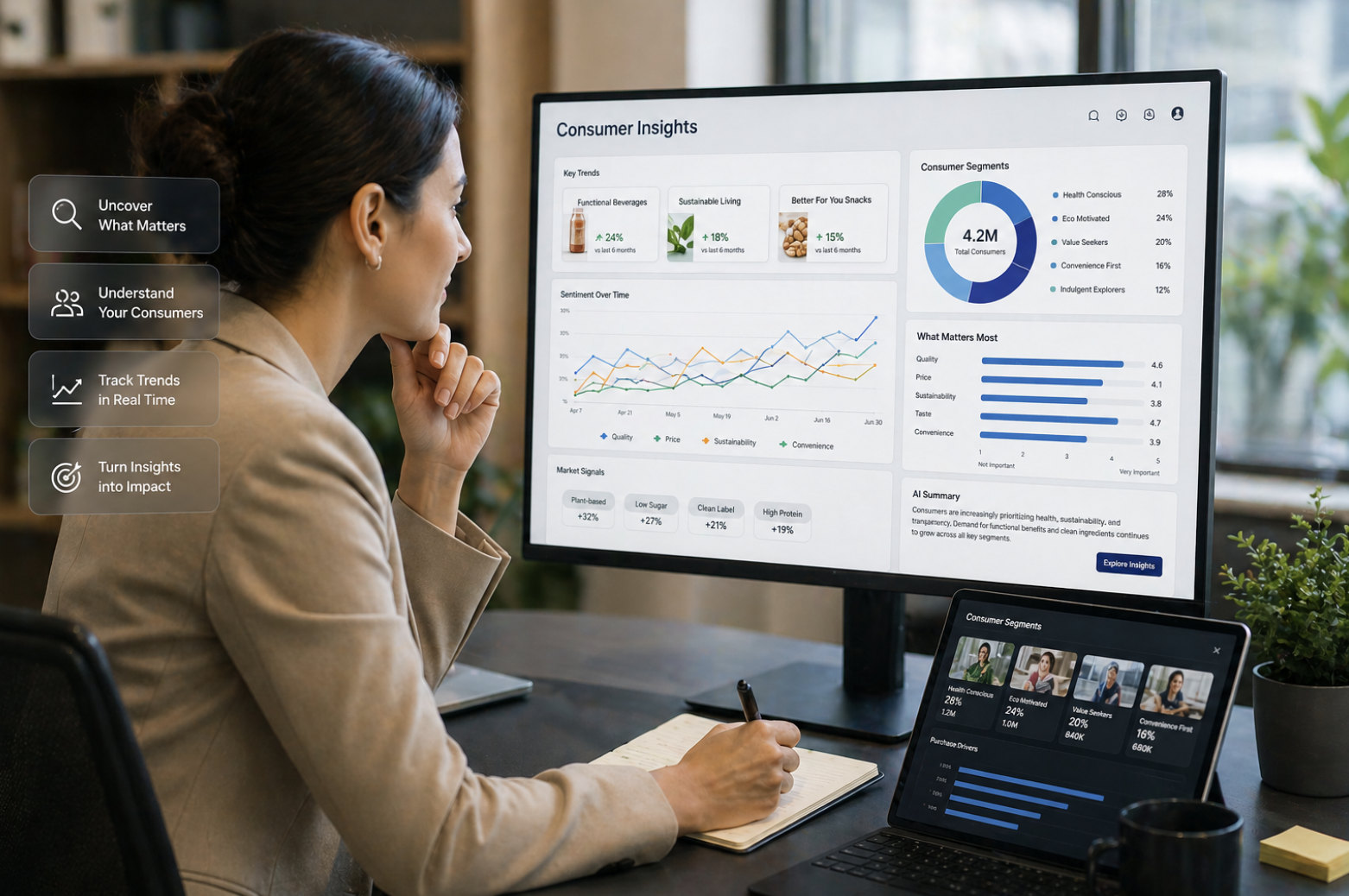
What a Modern Consumer Insights Platform Should Actually Do
The consumer insights function in a consumer goods company has one job: to ensure that every major decision — from product development to pricing to marketing investment — is grounded in a genuine understanding of the consumer.
That sounds straightforward. In practice, it requires synthesising information from a huge range of sources, translating raw data into actionable intelligence, and doing so quickly enough that the insight is still relevant by the time it reaches the decision-maker.
Most consumer insights platforms were built for a slower version of this challenge. The question for insights leaders in 2025 is what the function — and the tools that support it — need to look like now.
The Gap Between What Insights Teams Have and What They Need
In conversations with insights professionals across the consumer goods industry, a consistent picture emerges. Teams have more data than ever before. They have less time than ever to synthesise it. And the gap between when an insight is generated and when it reaches the people who need it is often wide enough that its commercial relevance has diminished by the time it arrives.
The sources are familiar: tracking studies, usage and attitude research, focus groups, concept tests, POS analytics, loyalty data, social listening reports. Each of these produces valuable information. But they are largely disconnected from each other, operated on different timelines, and interpreted by different people using different methodologies.
The result is that most insights functions are producing a lot of outputs — reports, presentations, dashboards — without necessarily improving the quality of decisions in proportion to the effort invested.
The Five Things a Modern Consumer Insights Platform Should Deliver
1. Real-time signal, not just periodic reporting
Consumer behaviour does not wait for your quarterly tracking study. A modern insights platform should be monitoring the signals that indicate shifts in consumer preference continuously — not generating a snapshot every three months. This means live data from social media, search trends, review platforms, and behavioural sources that update daily, not annually.
2. Integrated data, not fragmented sources
The value of consumer insight increases dramatically when multiple data sources are synthesised into a single view. A platform that shows you social sentiment alongside retail sales data alongside trend trajectory alongside competitive activity gives your team a fundamentally richer picture than any single source could provide. Integration is not a nice-to-have — it is the core value proposition of a modern insights infrastructure.
3. Forward-looking intelligence, not just backward-looking measurement
Measurement tells you what happened. Intelligence tells you what is likely to happen next. The most valuable consumer insights for commercial decision-making are predictive: which consumer needs are growing, which trends are approaching mainstream adoption, which categories are about to face disruption. A platform that only measures the past is a reporting tool. A platform that anticipates the future is a strategic asset.
4. Accessibility across the organisation
Consumer insights are only valuable if they reach the people who can act on them. In most consumer goods companies, insights are generated by a central function and distributed via periodic presentations — which means that a sales director preparing for a key account meeting, or an innovation manager evaluating a new concept, often does not have access to the most current consumer intelligence when they need it. A modern insights platform should democratise access to data, making relevant consumer intelligence available to sales, marketing, innovation, and management teams in a format they can actually use.
5. A clear line from insight to action
Data without a clear implication for action is not insight — it is information. The best consumer insights platforms close the loop between what the data shows and what the organisation should do about it. This means built-in frameworks for evaluating trend commercial potential, tools for translating trend data into innovation briefs, and reporting capabilities that make it easy to build a business case from the data rather than starting from scratch every time.
Why Real-Time Data Is Raising the Bar
The most significant shift in consumer insights over the past three years is not a new research methodology or a new analytical technique. It is the availability of real-time data at a scale and cost that was previously inaccessible to all but the largest consumer goods multinationals.
The combination of AI-powered data collection, natural language processing for social and review data, and machine learning for pattern recognition means that consumer signals which previously required weeks of research to detect can now be identified in hours or days. This is not a marginal improvement — it fundamentally changes the role that insights can play in a consumer goods business.
When insights are fast enough to be relevant to a decision that is being made this week — not a decision that was made last quarter — the function moves from support role to strategic advantage. That shift is available to any consumer goods company that invests in the right tools. But it requires being honest about whether the current insights infrastructure is built for the speed the business needs.
Evaluating Your Current Insights Capability
A useful diagnostic for insights leaders is to ask a simple question: how long does it take, from a consumer signal emerging in the market, to that signal influencing a commercial decision in your organisation?
If the answer is measured in months, you have a speed problem. If the answer is measured in weeks, you are closer to the pace the market requires but still likely missing early-stage opportunities. If the answer is measured in days, you are operating at the frontier of what modern consumer insights can deliver — and you are building a structural competitive advantage.
Closing the gap between signal and decision requires both better tools and a willingness to redesign the processes through which insights flow into the business. Technology solves the data problem. The organisational challenge — making sure insights reach decision-makers in time to be useful — is the one that insights leaders have to solve themselves.
Trendable is a real-time consumer insights platform built for the consumer goods industry. Apply for a free trial and see how fast your category intelligence can move.