How the Best KAMs Win Retail Negotiations — And What Data Has to Do With It
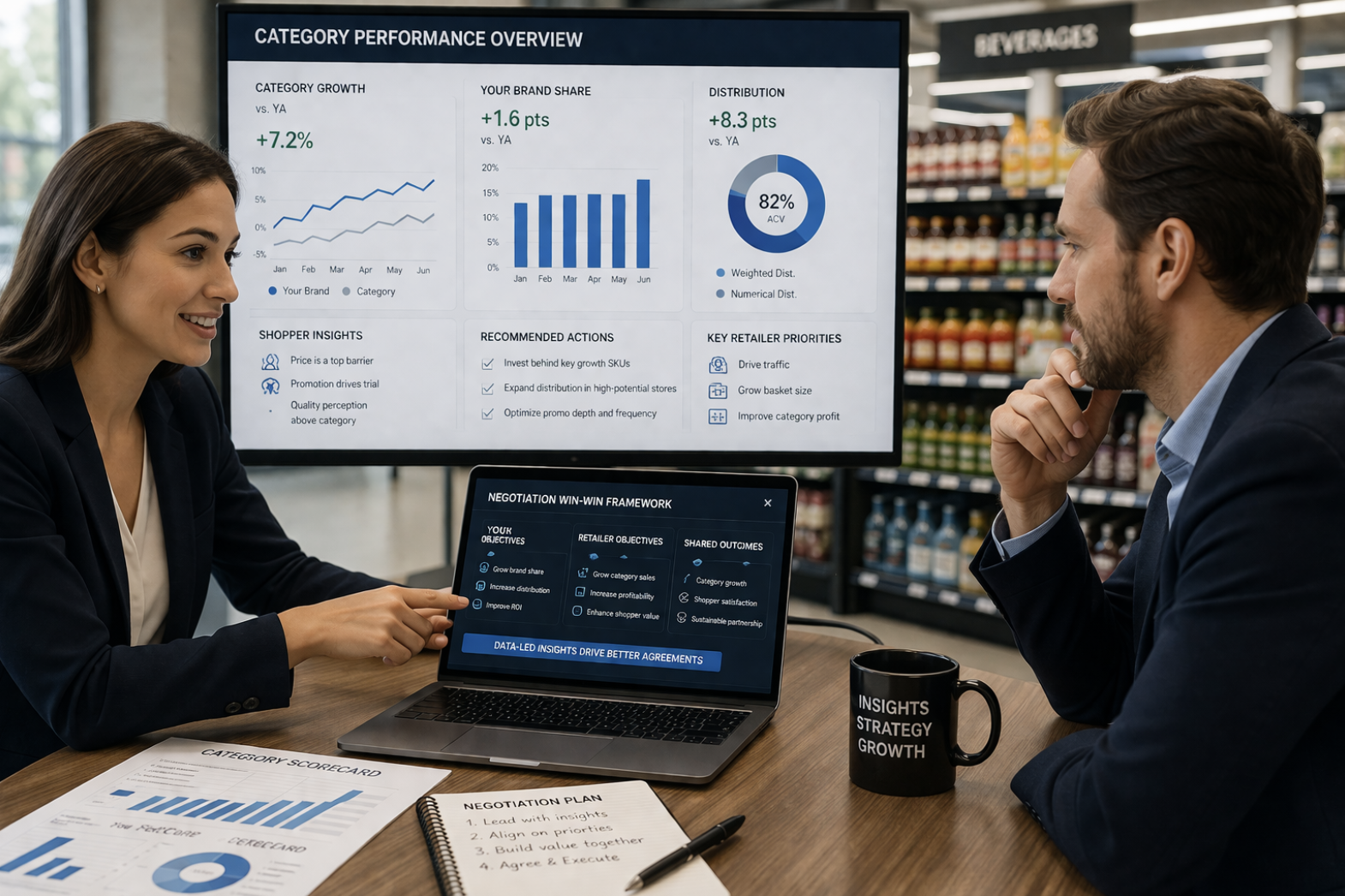
How the Best KAMs Win Retail Negotiations — And What Data Has to Do With It
In consumer goods, the retail negotiation is where strategy meets reality. All the brand investment, all the product innovation, all the category thinking — it either pays off or it doesn't based on what happens in that room.
The key account manager sitting across from a retail buyer is being evaluated on one thing above everything else: are they bringing something valuable? Not just a sales pitch for their own brand, but a genuine perspective on the category — something the retailer cannot easily generate themselves, that helps the retailer's customer buy better and the retailer's category grow.
The KAMs who consistently win ranging decisions, secure promotional investment, and build long-term retailer relationships are the ones who show up with that perspective. And increasingly, the difference between having it and not having it comes down to data.
What Retail Buyers Actually Want From Suppliers
Retail buyers are under significant pressure. They are responsible for the performance of their category across hundreds of SKUs, dozens of suppliers, and a consumer base whose preferences are shifting faster than ever. They have access to their own POS data and loyalty analytics. What they often don't have is external intelligence — a window into what is happening outside their own four walls that is about to walk through their doors.
When a supplier shows up with genuine external market intelligence — evidence of where consumer preferences are moving, what is gaining traction in restaurant menus and social media before it hits retail, what competitors in adjacent markets have already launched and how consumers are responding — they are providing something the retailer genuinely values.
This is the foundation of the category captain role. Not owning the most shelf space, but being the supplier the retailer trusts most to understand what their consumer wants next.
The Data That Changes a Negotiation
Not all data is equally persuasive in a retail negotiation context. Sales data tells a story about the past. Category trend data tells a story about the future. The future is what the buyer needs to plan for.
The most commercially effective data to bring into a range review or ranging negotiation includes trend trajectory data showing where consumer interest in a specific ingredient, format, or benefit is moving — ideally with a growth rate and a predicted peak timeline. Competitive market data showing how the category is evolving in comparable markets that typically lead your domestic market. Consumer sentiment data that explains why a trend is growing, not just that it is. And whitespace analysis that identifies unmet consumer needs the current range is not addressing.
Together, these sources allow a KAM to make an argument that goes beyond "our brand deserves more space" to "here is where the category is going, here is the evidence, and here is how our portfolio is positioned to capture that growth for you."
That is a fundamentally more persuasive conversation — and one that builds the kind of trust that translates into long-term commercial relationships.
Building the Pre-Negotiation Data Pack
The best KAMs treat data preparation for a major retail negotiation the same way a lawyer treats case preparation. They build a pack of evidence before they enter the room, structured around the arguments they need to make and the objections they need to anticipate.
A strong pre-negotiation data pack for a category range review typically includes a current category performance summary with honest acknowledgement of where the category is under-performing, an external trend analysis covering the next 12-18 months with specific evidence, a competitive benchmark comparing the retailer's current range against best-in-class ranges in comparable markets, a consumer need-state mapping that identifies gaps between what shoppers want and what is currently available, and a clear recommendation for range evolution with commercial projections.
The trend analysis section is the hardest to build well — and the most differentiated when done properly. If your team can walk into a range review with real-time data showing that a specific ingredient is up significantly in European restaurant menus over the past six months, that consumer search interest in a particular benefit is accelerating, and that two comparable international retailers have already listed products addressing this trend — that is not a conversation a buyer can dismiss. It is evidence-based category leadership.
How Trend Intelligence Changes the Sales Cycle
Beyond the negotiation room itself, real-time trend intelligence changes the entire rhythm of how KAMs engage with retail partners.
Instead of reactive account management — responding to retailer data requests, defending current listings, managing promotional calendars — a trend-informed KAM can be proactive. They can bring relevant market intelligence to every touchpoint with a buyer, establishing themselves as a source of category expertise rather than just another supplier competing for shelf space.
This proactive posture is particularly valuable in the months before a formal range review. A KAM who has been sharing relevant trend data consistently throughout the year arrives at the negotiation with established credibility. The evidence they present in the room has context — the buyer has been seeing the same trend build in the data they have been sharing all year. The recommendation feels like a natural conclusion, not a sales pitch.
The Competitive Advantage Is Still Accessible
Most KAMs in the consumer goods industry are still working primarily from internal sales data and periodic market research reports. The number of commercial teams systematically using real-time external trend intelligence in their account management and negotiation preparation is still relatively small.
That creates a genuine first-mover advantage for the teams that move now. The category captain position is not given — it is earned, and it is earned by being more useful to a retailer than any other supplier in the category. In 2025, being more useful means bringing better, faster intelligence.
The tools to do this are accessible. The question is whether your commercial team is using them.
Trendable gives commercial and KAM teams real-time trend data to win category conversations and retail negotiations. Book a demo to see what the data says about your category right now.