Trend Forecasting Software in 2025: What Works, What Doesn't, and What to Look For
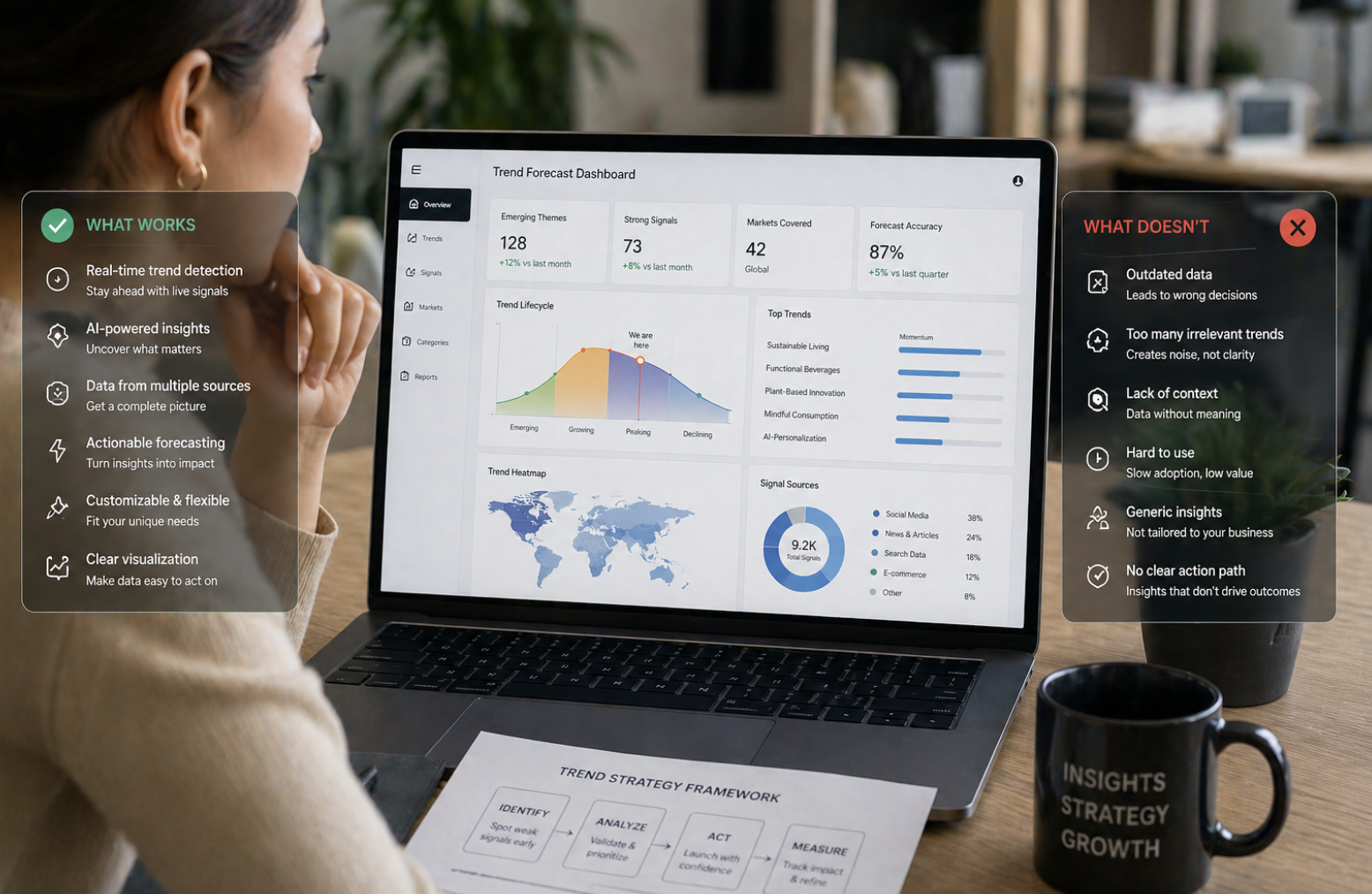
Trend Forecasting Software in 2025: What Works, What Doesn't, and What to Look For
The market for trend forecasting software has grown rapidly in the past few years, driven by the convergence of AI capability, the explosion of real-time data sources, and growing demand from consumer-facing businesses that have finally accepted that gut feel is not a scalable innovation strategy.
The result is a crowded market with a wide range in quality, and a lot of vendor language that sounds similar but describes very different products. If you are evaluating trend forecasting software for a consumer goods company, this guide is designed to help you cut through the noise and ask the right questions.
What Trend Forecasting Software Is — and Isn't
Let's start with what it is. Good trend forecasting software does three things: it collects signals from a broad range of relevant data sources, it applies analytical or AI-based methods to identify patterns that indicate emerging trends, and it presents those patterns in a way that is actionable for the teams using it.
What it is not is a crystal ball. No software can predict consumer behaviour with certainty. What the best platforms do is dramatically improve the quality of the probabilistic bets you are making — by grounding them in more data, processed faster, with clearer signal-to-noise filtering than human analysts working manually could achieve.
It is also not a replacement for commercial judgment. Trend forecasting software tells you what is moving. Your team still has to decide what to do about it — and that decision requires industry knowledge, creative thinking, and an understanding of your specific business context that no platform can replicate.
With those boundaries clear, here is what to look for.
The Seven Questions to Ask When Evaluating Trend Forecasting Software
1. What data sources does it actually pull from?
This is the most important question, and the one most vendors answer vaguely. The value of a trend forecasting platform is a direct function of the breadth and quality of its data. A platform that only monitors social media is missing the restaurant menus, retail launches, search trends, review data, and proprietary sources that provide a complete picture of where consumer preferences are moving.
Ask for a specific list of data sources. Ask how frequently they are updated. Ask whether they include international markets, and which ones. If the vendor cannot answer these questions precisely, treat that as a significant red flag.
2. How does it identify a trend — what is the methodology?
There is a meaningful difference between a platform that flags something as a trend because volume of mentions increased, and one that applies a more sophisticated analysis that accounts for growth trajectory, geographic spread, the profile of who is talking about it, and historical pattern-matching against similar trends.
Volume alone is a poor proxy for trend significance. Something can generate enormous social media volume and still be irrelevant to your category, or already past its commercial peak. Ask specifically how the platform distinguishes a genuine trend signal from noise, and how it ranks and prioritises what it surfaces.
3. How current is the data?
Some platforms present themselves as real-time while actually operating on weekly or monthly data refresh cycles. For trend forecasting in consumer goods, data recency matters. A trend that was notable last week may have already shifted. Ask specifically: how often is the data updated? How quickly do new signals appear in the platform after they emerge in the market?
4. Is it built for your industry, or adapted from something else?
Generic trend monitoring tools built for brand management or PR have been adapted for the FMCG market with varying degrees of success. The difference between a tool built specifically for consumer goods and one that has been repositioned for it shows up in the specificity of the data sources, the relevance of the trend categories, and the workflow integration with the decisions FMCG teams actually need to make.
Ask whether the platform tracks restaurant menus — one of the most reliable early-stage signals for food and beverage trends. Ask whether it has category-specific filters for your specific segment. Ask whether the language used to describe trends matches how your team actually thinks about your category.
5. How does it help you act on what it finds?
A dashboard full of trend data that your team has to manually interpret and translate into presentations, innovation briefs, and commercial recommendations is a data tool, not a decision-support tool. The best trend forecasting platforms close the loop between insight and action — with built-in tools for building category stories, generating trend reports, and connecting trend data to your internal planning processes.
6. Can it integrate with the data you already have?
The full value of trend forecasting data emerges when it can be interpreted alongside your internal sales data, your distribution data, and your customer data. Ask whether the platform offers API access, integration with BI tools like Power BI or Tableau, or data export capabilities that make it practical to combine external trend intelligence with internal performance data.
7. What does success look like — and how is it measured?
Before signing any contract, be specific about what you are trying to achieve. Are you trying to improve your new product hit rate? Accelerate your innovation cycle? Improve the quality of your retailer category presentations? Reduce the time your insights team spends on manual data collection?
Ask the vendor for case studies that demonstrate measurable impact on outcomes like these — not just platform usage metrics. The right measure of a trend forecasting tool is not how much data it produces. It is whether the decisions made using it produce better commercial results.
The Price Question
Trend forecasting software spans a very wide price range, from accessible self-serve tools to enterprise contracts that represent a meaningful budget commitment. Price does not correlate reliably with quality — there are expensive platforms with poor data and accessible platforms with genuinely powerful capabilities.
The right framework for evaluating price is ROI, not absolute cost. If a platform costs 100,000 NOK per year and prevents one significant product launch failure, it has paid for itself many times over. If it costs the same amount and produces reports that your team reads once and sets aside, it is expensive regardless of the absolute number.
The ROI calculation is more straightforward than it sounds: what is the commercial cost of your current trend intelligence gap, and how much of that cost would better software realistically address?
Making the Right Choice
The trend forecasting software market will continue to evolve rapidly. The platforms that are leading today are investing heavily in expanding their data sources, improving their AI models, and building deeper workflow integrations. The gap between the best platforms and the median is likely to widen rather than narrow.
For consumer goods companies, the decision is not really whether to invest in trend forecasting capability — the competitive cost of not doing so is becoming too high. The decision is which platform is the right fit for your specific use case, your team's workflow, and the decisions you most need to improve.
Start with the questions above. Insist on specific answers. Run a structured pilot on a category you know well, so you can evaluate the quality of the platform's output against your own expertise. And measure the outcome in commercial terms, not data terms.
Trendable is trend forecasting software built specifically for consumer goods companies. Track 100M+ data points daily across the sources that matter for your category. Book a demo or apply for a free trial.